AI for AI® · DSAIL® Verification Engine
What is DSAIL®?
A verification layer for AI-driven decisions.
DSAIL® (Domain-Specific AI Language) is the core of the Jaxon product — a powerful neurosymbolic engine that brings structure, control, and trust to LLM-driven workflows.
PROVE EVERYTHING with AI You Can Trust
Policy-as-Code
Write rules in natural, human-readable terms that get translated into structured logic.
Trust, but Verify
Combine LLMs with symbolic reasoning to validate outputs instead of blindly accepting them.
Catch Violations
Build complex, multi-step validation workflows that are both testable and transparent.
Scale Safely
Every DSAIL® rule is a guardrail — and if it breaks, you’ll know exactly why.
An example
Four claims from one plain sentence
Set up once from your written policy. Then every new request is checked the same way.
Set up once
Then, for each new request
Set up once · Step 1
Start with your policy
Use the policy you already have, in plain English. No code and no special format.
DSAIL® works from the line that sets the rule.
4.1 Shipping. Standard orders ship within 2 business days. Expedited shipping is available at checkout.
4.2 Exchanges. Items can be exchanged for a different size or color within 45 days.
The policy DSAIL uses4.3 Returns. Returns are accepted within 30 days of purchase if the item is unused and the customer has the receipt.
4.4 Refunds. Approved refunds go back to the original payment method within 5 business days.
Set up once · Step 2
DSAIL® builds the rule
DSAIL turns the policy into a rule with blanks, the questions to ask about each request, and code it can run.
Your team reviews it once before it goes live.
The rule, with blanks
Return accepted if bought [purchase date] and returned [return date] (30 days or less), the item is [condition], and the customer [has / doesn’t have] the receipt.
Questions to ask
- 1When was it bought?
- 2When was it returned?
- 3Is the item unused?
- 4Does the customer have the receipt?
Code DSAIL runs
assert return_accepted { returned - bought <= 30 "days" AND itemUnused AND hasReceipt};Each new request · Step 3
A request comes in
A customer emails asking to return a jacket. This message is the input DSAIL checks.
Most of it doesn’t matter to the rule. The LLM only pulls out the part that does.
Steps 1 and 2 don’t repeat. The same approved rule handles every request.
New return request
Hi there,
I’d like to return a jacket from order #48213. It ran a little big and the color was darker than the photos.
The part the LLM usesI bought it October 15 and sent it back November 6. I never wore it and I kept the receipt.
Let me know if you need anything else. Thanks!
Sandie
Each new request · Step 4
The LLM answers the questions
It reads the email and answers each question with a line from the message.
It only answers. It never decides the outcome.
From Sandie’s email
“I bought it October 15 and sent it back November 6. I never wore it and I kept the receipt.”
- When was it bought? October 15
- When was it returned? November 6
- Is the item unused? Yes
- Does the customer have the receipt? Yes
The rule, filled in
Return accepted if bought October 15 and returned November 6 (30 days or less), the item is unused, and the customer has the receipt.
Each new request · Step 5
DSAIL® decides
DSAIL runs the code on those answers. Formal logic, not an AI model, so the same answers always get the same verdict.
assert return_accepted { returned - bought <= 30 "days"22 daysTrue AND itemUnusedyesTrue AND hasReceiptyesTrue};Verdict
Return acceptedEvery condition is TRUE, so the return is accepted.
Watch the demo
See DSAIL® in action.
A recorded walkthrough of DSAIL® applying the SEAD-4 adjudicative guidelines, from the source document to a verdict traced back to the guideline that decided it.
AI Systems Can Sound Right — And Still Be Wrong
Plausible outputs aren’t proof.
Large language models generate responses probabilistically. That works for creativity — not for compliance, risk, or operational decisioning.
AI Verification Agent
Jaxon’s DSAIL® transforms policy into executable logic. Instead of trusting model output, DSAIL® validates it against structured rules derived from your internal doctrine and regulatory requirements.
The result: AI decisions that are testable, auditable, and enforceable.
Benchmarked against frontier AI on SEAD-4
The only system in the test that could prove it
We ran 65 rule evaluations from the SEAD-4 National Security Adjudicative Guidelines against nine synthetic background investigation reports, five trials each. The same frontier models ran with DSAIL® and without it, using a tuned prompt, retrieval (RAG), or a second model acting as judge. Same rules, same reports, same ground truth.
| With DSAIL® | Without DSAIL® | ||||
|---|---|---|---|---|---|
| Metric | Claude Opus 5.5 | GPT 5.6 Sol | Claude Opus 5.5 (prompt) | GPT 5.6 Sol (prompt) | GPT 5.6 Sol + RAG (best) |
| Consistency | 100% | 100% | 89.2% | 95.4% | 95.4% |
| Correctness | 100% | 100% | 60.0% | 78.5% | 73.8% |
| Runtime (seconds) | 195 | 128 | 240 | 136 | 161 |
| Auditability | ✓ | ✓ | ✗ | ✗ | ✗ |
Inside DSAIL®, both models returned the correct verdict on every rule in every trial, faster than the same models on a plain prompt. Without it, 649 of 983 wrong verdicts were a TRUE or FALSE on a rule the report left open. A second model reviewing the first did not close the gap: the best LLM-as-Judge pairing stayed at 78% correct. Only DSAIL® left a reasoning trace on every determination. Read the full methodology at jaxon.ai/benchmark.

Fact Checker
DSAIL®’s verification engine translates natural language policy into structured, enforceable logic.
Every AI output is tested against explicit rules before it’s returned — ensuring decisions are constrained, auditable, and aligned to your specifications.
Verification & Validation
Independent verification of LLM outputs.
Under the hood, Jaxon enforces this flow using a policy-based verification engine.
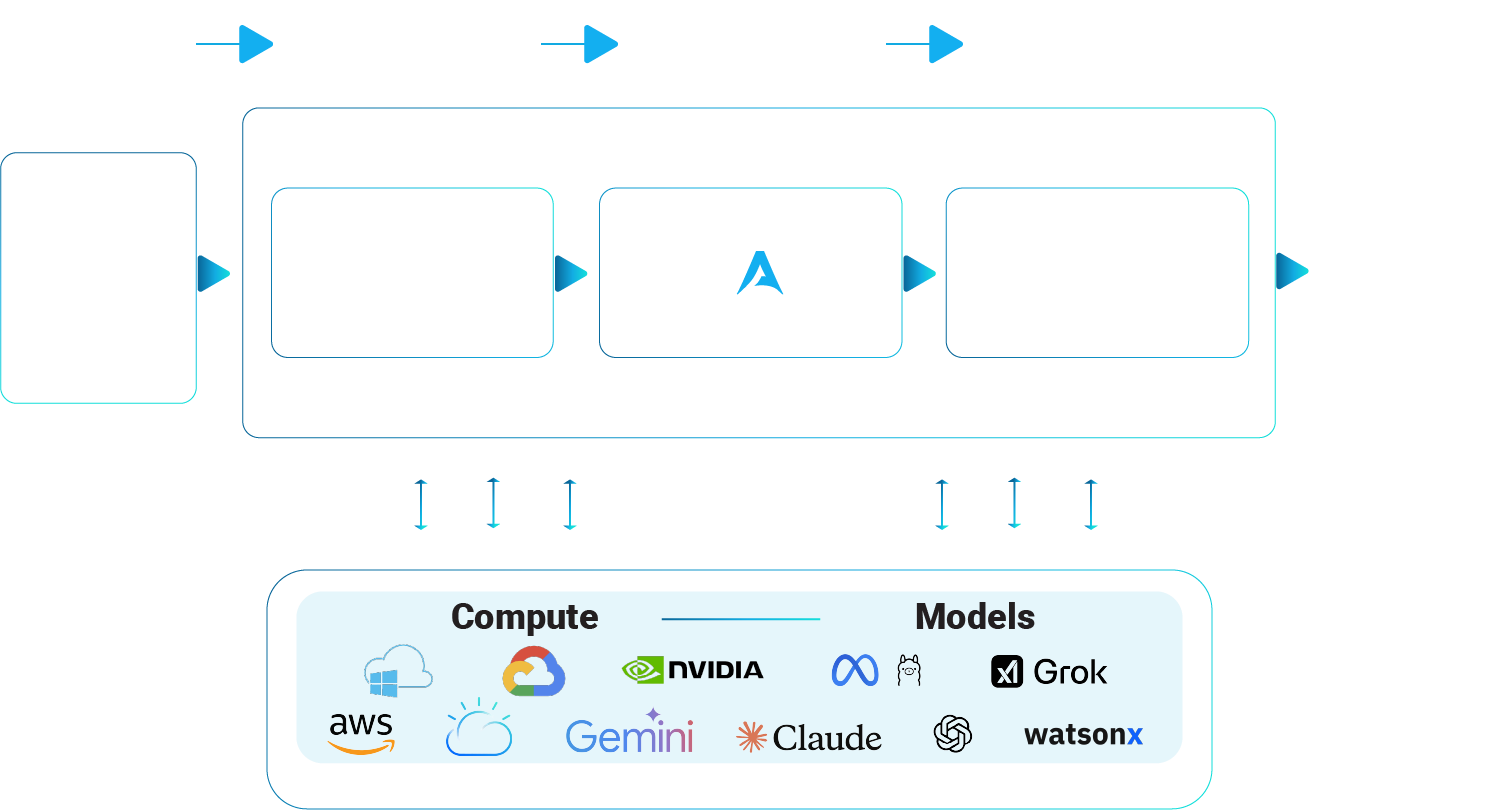
Structured logic ensures decisions meet defined specifications.
AI for AI · Open, Flexible, & Portable
Deploy Anywhere. Integrate with Any Model.
Jaxon is model agnostic and infrastructure-flexible.
Run across leading foundation models or self-hosted LLMs and deploy securely in your cloud or on-prem environment — without vendor lock-in or forced data movement.
LLM Proxy: Easily switch LLM providers — no code changes required.
Trust Generative AI for Critical Applications
AI guardrails impose user-defined constraints, ensuring AI outputs remain accurate & relevant.
Custom Tailored
Knowledge bases tailored to your data and use cases.
Formal Verification
Mathematically proves outputs align with policy.
Guardrails in Place
Deploy guardrails across new and existing LLM workflows.
The Jaxon Advantage
Transform how you build and trust AI.
Whether you embed Jaxon, integrate it, or have us manage it for you, our mission is the same: to make AI decisions verifiable, transparent, and enterprise-ready.
With Jaxon’s trust layer, every LLM output is governed by reliable, traceable verification.
Delivery Models
How Jaxon Fits Into Your Platform
Embed Jaxon Into Your AI Workflows
Build with Jaxon to bring verified LLM decisioning into your enterprise architecture. We’re LLM agnostic, on-prem capable, and API-first — making it simple for your team to integrate verified AI into any workflow, model, or environment.
Explore Jaxon APIWhy Partner with Jaxon
- Seamlessly embed verified AI into your workflows.
- Strengthen your platform with explainable and auditable AI outputs.
- Deploy through modules, embedded APIs, or private-label integrations.
NewUse DSAIL® in your AI assistant
Now available in the Claude and ChatGPT plugin directories
DSAIL® turns a written policy into rules a program can check, right inside your chat. Setup takes about ten minutes, and you create your Jaxon account along the way.
Claude
- On claude.ai, open Customize, then Plugins. In the desktop app, open Settings, then Plugins.
- Search
DSAILand click Add on DSAIL: Rules Engine for Written Policy. - On the plugin’s Connectors tab, click Connect, sign in, and Approve.
ChatGPT
- In ChatGPT, open the Plugins page.
- Search
DSAILand click + next to DSAIL from Jaxon, Inc. - Sign in or create your account, then Approve.
Sign in to both with the same Jaxon account and the rulesets you save in one show up in the other. The free tier includes 1,000 Jaxon Verified Units, and only checks count toward it.